
Whole-Structure Fumigation in San Francisco, CA
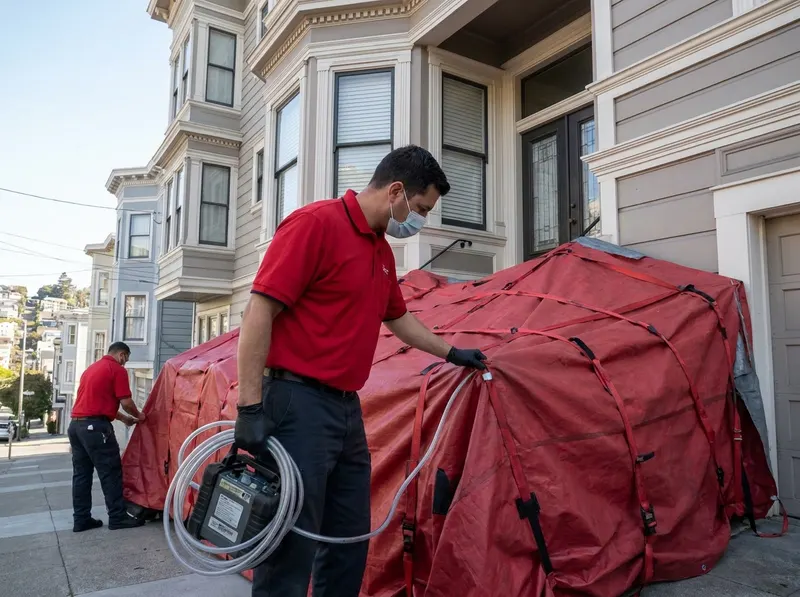
- Included: on-site inspection and probing of accessible framing, a written scope naming the pest and the affected areas, coordination of the tenting and licensed fumigation crew, your preparation checklist, permit and notification paperwork, and a post-fumigation walkthrough with sealing recommendations.
- Timeline: inspection usually within a few days of your call; tenting itself typically takes 2 to 3 days start to finish, with occupants, pets, and plants out of the building for that period.
- Cost: whole-structure fumigation in San Francisco commonly falls in the $1,800 to $9,000 range depending on cubic footage, number of stories, and whether the building is attached; our minimum charge for any visit is $250. All figures are ballparks until measured.
- Payment: terms are stated in writing with the scope before any tarp is ordered; card and check are typical for structural fumigation work, and no 12-month service contract is required to get an inspection.
- Booking: call (628) 278-5478 for a free on-site visit — we will tell you plainly if fumigation is not the right answer for your building.
Fumigation fits a narrow set of San Francisco problems well. It is the honest choice when drywood termite galleries or frass show up in multiple separate areas — a Noe Valley stair stringer, a second-floor window header, and an attic rafter all at once — or when wood-boring beetles are active in structural lumber, or when a whole small building has a bed bug problem that unit-by-unit treatment has failed to hold. The advantage is reach: gas moves through every void, wall cavity, and joist bay simultaneously, including the ones no technician can drill. The trade-off matters just as much. Fumigation leaves no residual whatsoever, so the wood is not protected the day after the tarps come off, and it does nothing for subterranean termites working up from the soil — a real consideration in the damp, fog-fed western half of the city near Ocean Beach and Lake Merced, where soil-borne colonies are more common than drywood ones. If the damage is confined to one accessible area, localized foam or borate injection plus moisture correction usually costs a fraction of a tent and does not put you in a hotel.
San Francisco's building stock decides feasibility more than the pest does. Detached and semi-detached homes with a driveway or side yard — much of the Outer Sunset, Excelsior, and parts of Bayview-Hunters Point — tent cleanly. Attached Victorian and Edwardian flats in the Mission District, North Beach, and along the Inner Richmond avenues are harder: the tarp has to seal at party walls and parapets, roof access is often through a neighbor's building, and adjacent occupants must be notified and sometimes temporarily relocated. On the steep blocks of Bernal Heights, Potrero Hill, and Glen Park, we also plan crew parking and equipment staging before we schedule, because a fumigation truck cannot circle for an hour. Coastal wind and fog affect tarp handling, so we build weather flexibility into the date rather than promising a fixed morning and no-showing.
Our sequence is inspection first, always. We probe and moisture-read accessible framing, sub-areas, and garage-level structure, identify the actual species, and map how far the activity extends. That report is what tells you whether a tent is justified — and we would rather lose the job than sell one to a household that needs $600 of targeted work and a sealed crawlspace vent. When fumigation is warranted, the tenting and gas application are carried out by licensed structural fumigation crews under California requirements, and we handle the scoping, coordination, and the part most companies skip: what happens after. Fumigant kills what is inside the wood on that day. Sealing entry points, correcting the leak or grade problem that kept the framing damp, and scheduling a follow-up inspection is what keeps it from coming back.
Preparation is real work, and we walk you through it in writing: food, medicine, and pet treats either removed or double-bagged in the specialized bags provided, plants and pets out, aquariums out, gas service shut off and relit by the utility, and all occupants — including anyone in an in-law unit or a shared-wall flat — out of the building for the full period. Households with young children, cats, or an asthma sufferer often ask whether the house is safe afterward. The straight answer: the fumigant used in structural work is a gas with no residue, and the building is cleared and tested by the fumigation crew before anyone re-enters, which is a different safety profile than a residual spray left on your base
Call (628) 278-5478