
Mouse Control in San Francisco, CA
- Pest Control Service in San Francisco
- Rat Control
- Rodent Exclusion & Entry Sealing
- German Cockroach Treatment
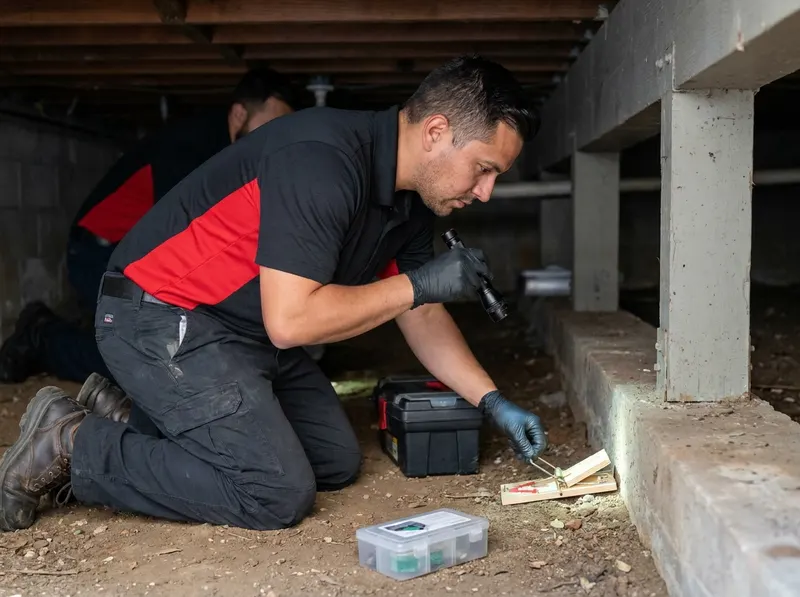
- What's included: a full interior and exterior inspection (kitchen cabinet bases, under-sink plumbing penetrations, stove and dishwasher voids, crawlspace, garage), entry-point mapping, monitored snap trapping in tamper-resistant placements, sealing of accessible gaps, and written notes you can hand a landlord or property manager.
- How fast: most San Francisco homes get an appointment within a few business days, and active trapping usually shows a clear drop within the first one to two weeks.
- What it costs: mouse work starts at $250 for a single unit; typical multi-visit programs with sealing land in the $350–$900 range, and every figure here is a ballpark confirmed exactly during a free on-site visit.
- What we take: common payment methods including card and check — confirm what suits you when you book, and no 12-month contract is required for a single inspection.
- How to book: call or text (628) 278-5478, tell us the neighborhood, the building type (flat, in-law unit, mixed-use), and where you're seeing droppings; we'll give a written estimate before work starts.
Mice and rats get lumped together and shouldn't be. Mouse droppings are the size of a rice grain and turn up in silverware drawers, behind the toe-kick of a kitchen cabinet, and inside stove insulation; rat droppings are closer to a raisin and cluster along runways in a crawlspace or garage. That difference changes the whole job. <strong>Mice need a quarter-inch gap, so sealing has to be done with quarter-inch hardware cloth and copper mesh — steel wool alone rusts out and packs down within a season.</strong> Mice also nest in several places at once and breed quickly, which is why a single trap under the sink almost never ends it. We set trap lines in the voids they're actually traveling, then come back and read the results instead of guessing.
San Francisco's building stock hands mice a lot of doors. In Outer Sunset houses the garage sits below the living space, and after years of wind-driven sand off Ocean Beach the door sweep and the frame gap open up just enough — mice enter at the garage and travel the plumbing chase straight up into the kitchen. Inner Richmond and Inner Sunset flats backing onto the Golden Gate Park panhandle of greenery tend to see pressure from ivy and dense plantings against the foundation. Bernal Heights and Glen Park in-law units are common problem spots because they were often finished without sealing the original crawlspace penetrations, so the unit shares air — and mice — with the space under the main house. Potrero Hill's stepped hillside foundations leave short crawlspace runs with multiple grade-level vents. North Beach and Mission District mixed-use blocks add a ground-floor commercial neighbor, and in shared-wall buildings across Noe Valley, Excelsior and Bayview-Hunters Point the honest answer is that we can seal your unit tight and the source may still sit next door — which is exactly why we document what we found and give you the sanitation and exclusion notes to pass along.
On fit: if you've seen droppings in one cabinet, no gnawing on food packaging, and no scratching in walls at night, a single inspection with trapping and targeted sealing is usually the right call and the cheaper path. <strong>If you're hearing activity inside walls or ceilings, finding droppings in more than one room, or the unit sits above a restaurant or an unsealed garage, a multi-visit program is the better value</strong> — because reinfestation, not the first catch, is what people actually pay for twice. The trade-off is real: a one-visit job costs less today and carries more risk of a callback; a program costs more up front and includes the return visits that verify the seal held.
On the eco question — low-toxicity does not mean weak for mice. Mechanical trapping kills mice faster and more verifiably than bait, gives us a body count instead of a guess, and avoids a poisoned mouse dying inside a wall void in a Victorian flat where the smell lives with you for weeks. It also keeps secondary poisoning away from cats, dogs and the raptors nesting around Lands End and the Presidio. <strong>Where any product is used, we tell you the material, where it went, and how long to keep kids and pets clear.</strong> Find the entry. Seal it. Stay gone.
Call (628) 278-5478Mouse Control pricing in San Francisco
| Mouse inspection with trap setup and entry-point report, one unit | $250 – $375 |
| Standard mouse program: initial visit plus follow-ups, single-family home or flat | $400 – $750 |
| Mouse exclusion / sealing work (hardware cloth, copper mesh, door sweeps, vent screening) | $350 – $1,200+ depending on access |
| In-law unit or ADU added to a main-house mouse program | $250 – $450 |
| Multi-unit building mouse assessment with written documentation for tenants or PM | $450 – $1,100 |
| Crawlspace or under-sink sanitation and nesting-material cleanout | $300 – $850 |
Exact price confirmed free on-site before any work.
Mouse Control — questions, answered
How do I know it's mice and not rats in my San Francisco home?
Size of the droppings is the fastest tell: rice-grain droppings in drawers and cabinet bases point to house mice, while raisin-sized droppings along a garage or crawlspace runway point to Norway or roof rats. Mice also squeeze through quarter-inch gaps, so many San Francisco homes that were rat-proofed years ago still have mice. We confirm the species during the inspection before quoting any work.
What does mouse control cost in San Francisco?
Mouse work in San Francisco starts at $250 for a single unit, and most homes needing trapping plus sealing fall in the $400–$900 range. Cost tracks access more than square footage — a Potrero Hill crawlspace you can stand in prices differently than an 18-inch Mission District belly crawl. Ranges are ballparks; the exact price is confirmed on a free on-site visit before anything begins.
Are the products used for mouse control safe around my kids and cat in a San Francisco flat?
Mouse control in San Francisco flats is handled primarily with mechanical trapping in enclosed or out-of-reach placements, which keeps toxicants out of living space and avoids a poisoned mouse dying inside a wall void. If any product is applied, we name the material, show you where it went, and give a clear re-entry time for children and pets. You are entitled to ask what is being used, and we answer in plain language.
My neighbor's unit is the source — can you still help with mice in a shared-wall San Francisco building?
Yes, and that situation is common in Noe Valley, North Beach and Excelsior shared-wall buildings. We seal your unit's own penetrations, trap what's inside, and provide written notes on what we found so you can raise it with a landlord, HOA or property manager. We will not promise a shared-wall building stays mouse-free if an adjacent unit continues feeding the population — we'll tell you that up front instead of after.
Do I have to sign a contract for mouse control in San Francisco?
No — a single inspection and treatment visit is available on its own anywhere in San Francisco County, with no 12-month agreement required. Ongoing programs exist because reinfestation pressure in older San Francisco building stock is real, but they are a choice, not a condition of getting service. Call or text (628) 278-5478 and we'll explain which option actually fits what you're seeing.