
Drywood Termite Localized Treatment in San Francisco, CA
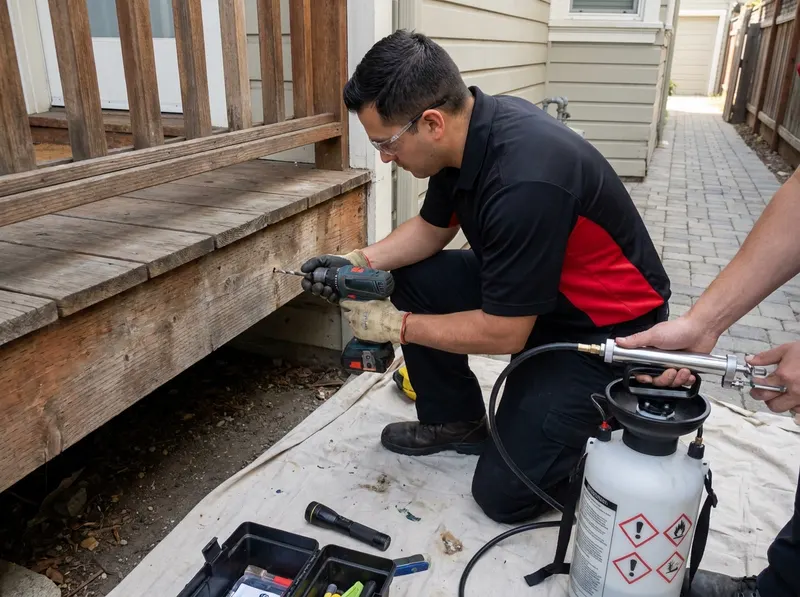
- What's included: on-site inspection of the suspect wood, sounding and probing to map the gallery, drill-and-inject treatment of the affected member, treatment of adjacent at-risk wood, and written notes on what was applied and where.
- How fast: most single-area drywood termite jobs in San Francisco are completed in one visit of about 1 to 3 hours, with no need to vacate the building for days.
- What it costs: localized drywood termite treatment in San Francisco typically runs $250 to $1,800 depending on how many wood members are involved and how accessible they are; $250 is our minimum charge.
- What we take: card, tap-to-pay and standard electronic payment at the property; no annual contract is required for a one-time localized treatment.
- How to book: call or text (628) 278-5478 with your neighborhood and a photo of the pellets or kick-out holes, and we'll schedule a free on-site visit in a set arrival time rather than a four-hour window.
Drywood termites announce themselves with pellets, not mud. The frass is hard, six-sided, tan-to-brown and about the size of coarse ground pepper, and it collects in small piles under a kick-out hole — on a painted window stool in an Inner Richmond bay, along the base of a garage door frame in the Outer Sunset, on the treads under an exterior stair stringer in North Beach. Sweep the pile up, mark the date, and check the same spot in a week. Fresh pellets mean a live colony in that timber. That single detail is what makes localized treatment defensible: drywood termites don't need soil, so their activity stays where the wood is, and a well-mapped infestation can be treated in place.
Localized treatment fits when the infestation is confined and reachable. Good candidates in San Francisco housing stock include sunny south- and west-facing exterior trim, window sashes and sills on Bernal Heights and Potrero Hill slopes, redwood fascia and rafter tails, unpainted garage framing, deck ledgers, and the exposed Douglas fir joists you can actually see from a Noe Valley or Glen Park basement. Fumigation is the honest answer instead when pellet piles show up in three or four separate parts of the building, when galleries run into inaccessible wall voids or stucco-clad framing, or when a Mission District Victorian has decades of layered remodeling that hides where the wood goes. We'll tell you which situation you're in on the visit, including when the smaller job isn't the right job.
The trade-off is worth stating plainly. Localized treatment costs far less, needs no move-out, no plant removal and no food bagging, and it protects indoor air for households with a toddler, an asthmatic or an indoor cat. What it does not do is treat wood nobody has inspected. Any colony in a member we never opened up stays untreated, which is why we schedule a follow-up look rather than declaring victory on day one. We won't promise total eradication of every termite in an old building — nobody honestly can — but we will show you the galleries we treated and the wood we're watching.
San Francisco's fog belt adds a wrinkle: moisture-softened wood along Ocean Beach, Lake Merced and the western avenues is also attractive to subterranean termites and to wood-decay fungus, and the treatment for those is different. Part of the inspection is confirming which insect you actually have before anything is drilled. On mixed-use and multi-unit buildings in Bayview-Hunters Point, the Excelsior and SoMa-adjacent blocks, we'll note the shared-wall and shared-framing risk in writing so a building manager has documentation before a tenant complaint escalates. Escrow and property-sale paperwork in California has its own licensing rules — ask us at the visit and we'll explain what applies to your property before you commit to anything. Find the entry. Seal it. Stay gone: after treatment we point out the bare wood, failed paint edges and open vent screens that let the next swarmer in, and that advice costs nothing.
Call (628) 278-5478Drywood Termite Localized Treatment pricing in San Francisco
| Free on-site drywood termite inspection with pellet identification | $0 |
| Single-area localized drill-and-inject (one sill, jamb or trim run) | $250 - $450 |
| Two to four separate wood members treated in one visit | $450 - $900 |
| Whole-room, garage framing or full exterior trim run | $900 - $1,800 |
| Borate surface treatment of exposed bare framing after repair | $300 - $700 |
| Follow-up visit with re-treatment of new pellet activity | $250 - $400 |
Exact price confirmed free on-site before any work.
Drywood Termite Localized Treatment — questions, answered
How do I know it's drywood termites and not subterranean termites in my San Francisco home?
Drywood termites leave hard six-sided pellets in small piles below tiny round kick-out holes, and they need no contact with soil. Subterranean termites in San Francisco leave mud tubes and moist packed soil in crawlspaces and along foundations instead of dry pellets. Photograph the debris and text it to (628) 278-5478 — the pellet shape is usually enough to tell the two apart before anyone visits.
Can localized treatment replace fumigation for a San Francisco Victorian?
Localized treatment replaces fumigation only when the drywood termite activity is confined to wood we can reach and map. Many San Francisco Victorians and Edwardians have layered remodels and stucco-clad framing that hide galleries, and in those cases whole-structure fumigation is the more honest recommendation. We inspect first and say which one your building needs rather than selling the smaller job by default.
Is the product used on drywood termites safe around kids and pets in a San Francisco flat?
Localized drywood termite treatment in San Francisco is injected into the wood cavity, not fogged into living space, and borate-based options are among the lower-toxicity choices for interior framing. We name the specific product on site, leave the label information with you, and give the re-entry and drying time before we start. Households with a toddler, a cat or an asthmatic should say so when booking so we can plan the sequence around it.
Do you treat garage and exterior trim termites in the Outer Sunset and Excelsior?
Yes — garage door frames, unpainted studs, fascia boards and window sills are the most common drywood termite sites we treat in the Outer Sunset, Excelsior, Bayview-Hunters Head and other western and southern San Francisco neighborhoods. Ground-floor garages under living space are especially worth checking because the framing is often bare and easy to inspect. Access from the driveway usually makes these jobs faster and cheaper than interior work.
Do I need a contract for a one-time drywood termite treatment in San Francisco?
No annual contract is required for a one-time localized drywood termite treatment in San Francisco. You can book a single inspection and a single treatment visit, with $250 as the minimum charge, and decide separately whether a follow-up check makes sense. Small building managers who want recurring documented visits can ask about that, but it is never a condition of getting the first job done.