
Ant Control in San Francisco, CA
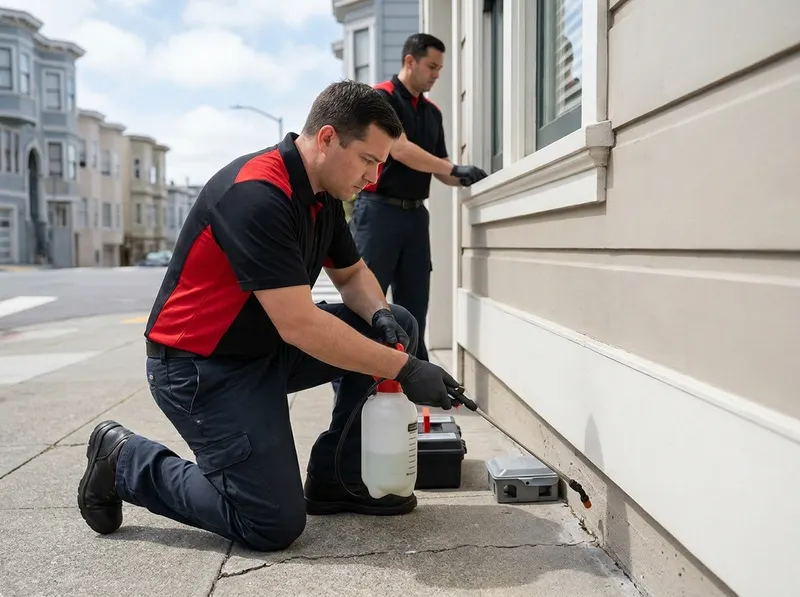
- What's included: full interior and exterior inspection, species ID, gel and granular baiting at active trails, targeted crack-and-crevice application where needed, exterior perimeter treatment, and a written list of entry points to seal.
- How fast: most single-unit ant visits take 45–90 minutes on site; trail activity usually drops noticeably within 3–7 days as bait moves through the colony, and one follow-up visit is included in the service window.
- What it costs: ant service in San Francisco typically runs $250–$575 for a flat or single-family home, with a $250 minimum charge. Ranges are ballparks — the exact price is confirmed on a free on-site visit.
- What we take: cash, card, check, and standard electronic transfer. No 12-month contract is required for a single ant inspection and treatment.
- How to book: call or text Eco Francisco at (628) 278-5478 with your neighborhood, building type and where you're seeing the trail; we schedule a set arrival time, not a four-hour window.
The decision that matters with San Francisco ants is bait versus barrier. Argentine ants form supercolonies with many queens, and a broad indoor spray kills foragers while scattering the rest — the colony often responds by budding into new satellite nests inside wall voids, which is exactly the wrong outcome in a Mission District Victorian flat with shared walls. <strong>Baiting is the primary method because the workers carry the active ingredient back to the queens and brood.</strong> Barrier work still has a place, but outside: a treated exterior perimeter, sidewalk expansion joints and the base of stucco or retaining walls stops the resupply from the street. In practice, indoor baiting plus outdoor perimeter is what holds; indoor spraying alone is what fails.
Geography drives the pattern here. Outer Sunset and the outer avenues sit on sand with fog-damp stucco foundations, so trails often surface at slab cracks and garage thresholds. Inner Richmond blocks near Golden Gate Park get pressure from street-tree roots and irrigated garden beds, with ants entering above grade along window sills. Bernal Heights, Glen Park and Potrero Hill all have hillside retaining walls and stepped foundations — reliable Argentine ant real estate, especially in the first warm days after a winter storm, when saturated soil pushes colonies toward dry interior voids. In North Beach and other mixed-use blocks, upstairs kitchens can pick up trails from ground-floor food handling, which is a building-wide problem, not a unit problem. <strong>Where units share a wall, treating one kitchen while the neighbor stays untreated usually means the trail returns within weeks.</strong>
Not every ant here is an Argentine ant, and the difference changes the plan. <strong>Carpenter ants nest in wet wood rather than soil</strong>, and in San Francisco they show up in aging fascia, deck ledgers, leaking bay-window sills and skylight curbs on Noe Valley and Excelsior homes — often with coarse sawdust-like shavings beneath the nest. Carpenter ant work is part inspection, part moisture repair referral: we can treat the galleries, but if the flashing or gutter that wetted the wood stays broken, the same void gets recolonized. Odorous house ants and pavement ants also turn up, and both respond well to bait placed at the actual trail rather than sprayed across a room. Species ID happens on the first visit and is explained in plain language before anything is applied.
Safety is the reason this method is built the way it is. Baits are placed in cracks, under appliances, inside cabinet voids and in tamper-resistant stations — not broadcast across countertops or floors where a toddler crawls or a cat walks. <strong>You'll be told the product name and where it went, and you can ask us to skip any room entirely.</strong> Free with every visit: the exclusion and sanitation list — the gap under your back door sweep, the unsealed drain penetration under the sink, the ivy touching siding in Bayview-Hunters Point yards, the sugar bowl on an open shelf. Sealing those is what makes the treatment last, and we'd rather you fix them than pay us monthly forever. Find the entry. Seal it. Stay gone.
Call (628) 278-5478Ant Control pricing in San Francisco
| Single flat, condo or in-law unit — interior baiting plus exterior perimeter check | $250–$375 |
| Single-family home — interior treatment plus full exterior perimeter and trail work | $350–$575 |
| Carpenter ant inspection with targeted gallery treatment and moisture findings report | $425–$800 |
| 2–4 unit building, coordinated same-day service across units and common areas | $550–$1,100 |
| Follow-up visit inside the service window | Included |
Exact price confirmed free on-site before any work.
Ant Control — questions, answered
What kind of ants are in San Francisco homes?
Argentine ants are the most common indoor ant in San Francisco, followed by odorous house ants, pavement ants near sidewalks and driveways, and carpenter ants in water-damaged wood. Species ID is done on the first visit, because Argentine ants are treated with bait aimed at an outdoor soil colony while carpenter ants require finding a nest inside wet framing, trim or a deck ledger.
Why do ants keep coming back after spraying in my San Francisco flat?
Ants return after spraying in San Francisco because sprays kill foragers, not the queens, and Argentine ant colonies here are large and multi-queened. Indoor spraying can also scatter a colony into wall voids — a real risk in older Victorian and Edwardian flats with shared walls. Slow-acting bait taken back to the nest, combined with exterior perimeter treatment and sealing entry points, is what actually ends the trail.
Is eco-friendly ant control strong enough for a real infestation in San Francisco?
Yes — low-toxicity ant control works in San Francisco because ants are killed by transfer, not by volume. Baits use small amounts of active ingredient that foragers carry to the queens and brood, which reaches parts of the colony no spray can touch. The trade-off is patience: expect a visible drop over several days rather than an instant empty floor, and expect a short-lived increase in ant traffic at bait points first, which means it's working.
How much does ant control cost in San Francisco?
Ant control in San Francisco typically runs $250–$375 for a single flat or condo and $350–$575 for a single-family home, with a $250 minimum charge. Carpenter ant work involving inspection and gallery treatment generally runs $425–$800, and small multi-unit buildings run $550–$1,100. These are ballpark market ranges; the exact price is confirmed during a free on-site visit once the species, access and building type are known.
Do I need a contract for ant service in San Francisco?
No contract is required for a one-time ant inspection and treatment anywhere in San Francisco, including Outer Sunset, Noe Valley, Potrero Hill and Excelsior. One follow-up visit is included in the service window. Ongoing scheduled visits are offered for buildings with continuous outside pressure — ground-floor food service, dense landscaping against the foundation, or neighboring units that stay untreated — but that is a choice, not a condition of booking. Call or text (628) 278-5478 to set a specific arrival time.