
Rodent Exclusion & Entry Sealing in San Francisco, CA
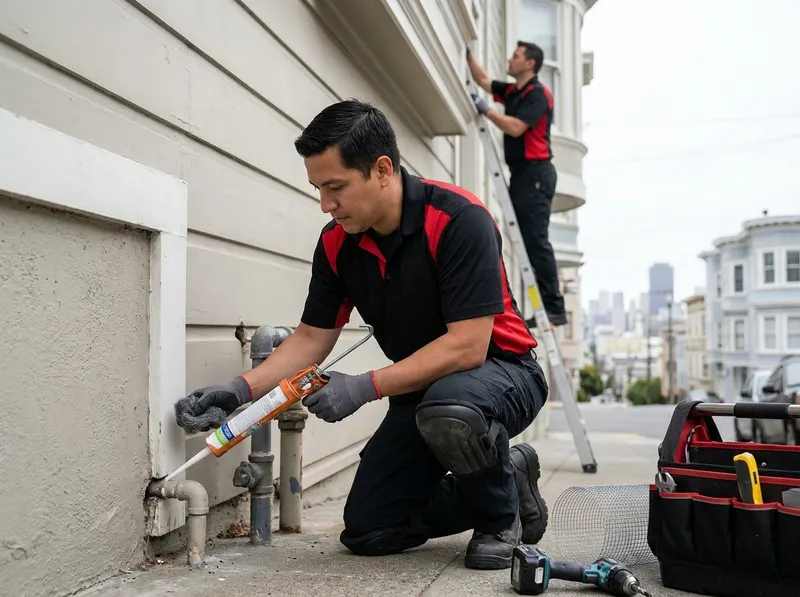
- Included: a top-to-bottom entry inspection (crawlspace, foundation line, garage, utility penetrations, roofline and vents), a written map of every opening found, sealing with rodent-rated metal and mesh, and free sanitation and yard-condition advice.
- Timeline: most single-family or single-flat exclusion jobs in San Francisco are completed in one to two visits; large or multi-unit buildings are usually staged over a week.
- Cost: exclusion work in San Francisco generally runs $450 to $3,500 depending on the number of openings and access difficulty, with a $250 minimum for inspection and a documented seal plan.
- What we handle: Norway rats along the ground and sewer lines, roof rats in attics and vine-covered rear walls, and house mice in shared-wall kitchens and mixed-use ground floors.
- Booking: call or text (628) 278-5478 for a free on-site inspection with an arrival time, not a four-hour window; no annual contract is required to get a one-time exclusion.
San Francisco's building stock is the reason exclusion beats repeat spraying here. A 1908 Edwardian flat in the Inner Richmond typically sits on a brick or unreinforced foundation with a vented crawlspace, a soil-side utility trench, and a light well that funnels a rat straight to the kitchen wall. Norway rats need roughly a half-inch gap; mice need a quarter-inch. That means the failure points are rarely dramatic — a rusted-out foundation vent screen, the gap around a gas line, a garage door with a worn bottom sweep, an abandoned sewer cleanout, or the open chase where a plumber cut through a joist bay and never patched it. <strong>We inspect for entry points before we ever discuss bait or traps.</strong>
Neighborhood conditions change the work. In the Outer Sunset, drifting sand from Ocean Beach undercuts garage thresholds and slab edges, so ground-level seals need metal flashing rather than mortar alone. Bernal Heights and Glen Park have hillside in-law units where the downhill crawlspace door is often the single largest opening on the property. Potrero Hill's stepped foundations create long horizontal ledges rats travel nightly. In North Beach and the Mission District, shared party walls and mixed-use ground floors mean a restaurant's grease line or a neighbor's unsealed basement keeps re-seeding the block — there we seal your envelope and tell you plainly what's coming from next door, because <strong>an honest boundary report is more useful than a promise we can't keep about a neighbor's building</strong>. Excelsior and Bayview-Hunters Point jobs often involve detached garages, rear cottages and fence-line vegetation that acts as a highway; Noe Valley Victorians frequently need roofline and vent screening where roof rats use overhanging trees and rear stairs.
When exclusion is the right call versus trapping alone: if you're hearing scratching in walls or ceilings, finding droppings that return within days of cleanup, or you've already paid for two rounds of trapping that fixed it temporarily, the openings are still there and sealing is the durable fix. Trapping alone makes sense for a single animal that got in through a door left open, or as the first phase when someone needs immediate relief tonight. <strong>The trade-off is real cost and real construction:</strong> exclusion takes hours of crawling, cutting and fastening, so it prices higher than a service call — and if the crawlspace has standing water, active knob-and-tube, or damaged subfloor, some repairs belong to a contractor before sealing makes sense. We'll say so instead of sealing over a problem.
On safety, exclusion is the least-toxic tool available: metal and mesh have no residue, nothing to off-gas, and nothing a toddler, cat or asthmatic household member can be exposed to. Where trapping is needed alongside sealing, we use tamper-resistant placements in the crawlspace, garage or wall void — away from living space — and we tell you exactly what is set and where. <strong>You get a written record of every opening and every material used,</strong> which is what a landlord or property manager in San Francisco County needs when documenting a habitability complaint. Find the entry. Seal it. Stay gone.
Call (628) 278-5478Rodent Exclusion & Entry Sealing pricing in San Francisco
| Inspection with written entry-point map and seal plan (minimum charge) | $250 – $375 |
| Targeted sealing, garage or crawlspace access points only | $450 – $950 |
| Single-family home or one flat, full perimeter exclusion | $1,200 – $2,400 |
| Multi-unit Victorian/Edwardian building, staged exclusion | $2,200 – $3,500+ |
| Foundation and dryer/utility vent screening (galvanized mesh) | $350 – $900 |
| Roofline, eave and attic vent exclusion for roof rats | $450 – $1,400 |
| Trapping and monitoring add-on, 2–3 follow-up visits | $300 – $700 |
| Crawlspace droppings and nesting cleanup with sanitizing | $350 – $1,000 |
Exact price confirmed free on-site before any work.
Rodent Exclusion & Entry Sealing — questions, answered
How long does rodent exclusion last on an older San Francisco Victorian?
Properly installed metal and mesh seals typically hold for years on San Francisco Victorians and Edwardians, because rodents cannot chew galvanized hardware cloth or sheet metal the way they chew foam, caulk or steel wool. Wood-frame movement, new plumbing or roof work, and a neighbor's demolition can open fresh gaps, so an annual walk of the foundation line is worth doing.
Can you seal my unit if the rats are coming from the building next door in the Mission District?
Yes — we seal your unit's envelope, and shared-wall situations in the Mission District and North Beach are exactly where exclusion earns its keep. We document any openings that originate in an adjoining property or common area so you can hand that to your landlord, HOA or property manager, since we can only perform work on the property that hires us.
Do I need trapping as well as entry sealing in San Francisco?
Usually yes, in that order of importance: sealing stops new rodents from entering, and trapping removes the ones already inside the San Francisco building. We generally seal the outside first, leave one controlled area for removal, then close it once activity stops — that prevents an animal being sealed into a wall void.
What does rodent-proofing a Sunset District garage cost?
Garage-focused exclusion in the Outer Sunset commonly runs $450 to $950, covering door sweeps, threshold flashing, foundation vents and utility penetrations. Blowing sand and older detached garages can add labor, so the ballpark is confirmed with an exact figure during a free on-site inspection; our minimum charge is $250.
Is a long-term contract required for rodent exclusion in San Francisco?
No — rodent exclusion in San Francisco can be booked as one-time work with no annual agreement. Some multi-unit buildings and mixed-use ground floors choose recurring monitoring after sealing because of ongoing pressure from the block, but that is a choice, not a condition of getting the exclusion done.